AI-Driven Development
Ad-hoc AI coding → governed Claude Code delivery loop with standards, app KBs, skills, commands, Jira context, and PR review gates.
- Role
- Forward Deployed AWS & GenAI Platform Architect
- Context
- Enterprise / Data & AI (NDA)
- Duration
- 6+ weeks foundation and rollout design
- Team
- Architecture working group + pilot engineering team
Tech stack
- Claude Code
- Anthropic
- Atlassian MCP
- Jira
- Confluence
- Bitbucket
- Markdown
- Obsidian
- Playwright
- Azure DevOps
- AWS Secrets Manager
- Java
- React
- TypeScript
- Python


Business problem and production context.
Business problem
The client wanted to move from AI as a small coding assistant toward AI-assisted delivery on real enterprise tickets. The risk was not model quality alone. Without repo standards, app memory, ticket structure, guardrails, and rollout sequencing, AI could generate code that compiles but does not fit the system, misses team conventions, or creates governance gaps.
Architecture decision
Designed the AI-driven delivery substrate: developer-facing standards, working-group program library, per-team application knowledge base, Claude Code slash commands, skill architecture, Jira/Confluence context flow, session logs, PR-review gates, and phased rollout from proof of concept to multi-team adoption. The approach kept human design and review as the quality gate while giving AI enough structured context to write useful implementation code and tests.
Before and after.
One command takes a ticket from loaded context to a reviewed pull request and an updated app knowledge base.
The developer workflow from ticket to reviewed pull request and knowledge base update. Source hosting and CI are not shown.
A design the engagement produced, not a running system.
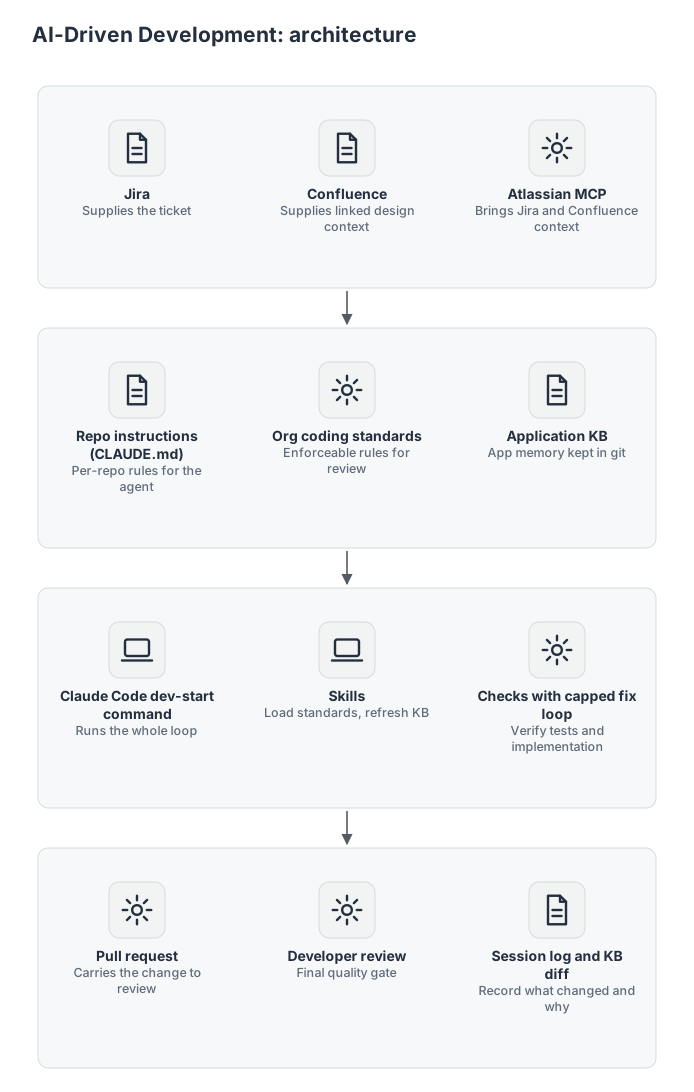
1. Work intake
Jira
Supplies the ticket
Confluence
Supplies linked design context
Atlassian MCP
Brings Jira and Confluence context
2. Context
Repo instructions (CLAUDE.md)
Per-repo rules for the agent
Org coding standards
Enforceable rules for review
Application KB
App memory kept in git
3. AI loop
Claude Code dev-start command
Runs the whole loop
Skills
Load standards, refresh KB
Checks with capped fix loop
Verify tests and implementation
4. Review and memory
Pull request
Carries the change to review
Developer review
Final quality gate
Session log and KB diff
Record what changed and why
How it works, step by step
- 1The developer runs one dev-start command with a Jira ticket or a work description.
- 2Claude Code reads the repo instructions, org coding standards, the ticket, linked Confluence design and the app KB.
- 3It confirms intent with the developer, then writes tests and implementation and runs checks in a capped fix loop.
- 4It opens a pull request, and the developer reviews and approves the change.
- 5It proposes a KB diff and a session log, which the developer confirms before the work counts as done.
Guardrails
- Intent confirmed before any code changes
- KB and session log updates confirmed before work is complete
- Developer review stays the final quality gate
- Org coding standards loaded at task start
- Fix loop on failing checks is capped
- Phased rollout from proof of concept to pilot, tests, then multiple teams
Considered and not used
- Many separate commands: One dev-start loop so developers do not forget wrap-up steps or split context across sessions.
- Confluence-only knowledge base: Git stays the source of truth for developer memory; Confluence is a mirror for nontechnical readers.
- Hidden hooks for context loading: Deferred until the workflow was understood; hidden loading is harder to debug during adoption.
My part of the work, separate from the team's.
The team behind the engagement is in the facts row above. These are the parts I was responsible for, and the artifacts that show the work.
Owned scope
- AI-driven delivery system architecture connecting tickets, design context, repo instructions, app memory, implementation, tests, pull requests, and KB/session-log updates
- Developer-facing standards and command/skill patterns so Claude Code worked from organization-specific rules instead of generic coding advice
- Rollout model from proof of concept to pilot, AI-authored test maturation, and multi-team adoption with developer review as the quality gate
Evidence artifacts
What would fail first?
Every project has constraints. The useful work is naming them early enough that rollback, cost, and ownership are designed before an incident.
Enterprise fit
AI output had to fit existing teams, Jira, Confluence, Bitbucket, Azure DevOps, and review practices instead of requiring a new delivery platform.
Context reliability
Claude Code needed durable app memory, coding standards, ticket context, and design boundaries before touching implementation code.
Governance
The workflow had to preserve human approval, auditability, secret hygiene, and controlled rollout across multiple product teams.
Trade-offs accepted on purpose.
Production risks and how they were controlled.
Small steps, visible changes, fewer surprises.
- 01
Mapped the target operating model: developer invokes a single Claude Code command, AI reads ticket/design/app context, confirms intent, writes code/tests, runs checks, opens a PR, then proposes KB/session-log updates.
- 02
Split the system into three source-of-truth layers: developer-facing vault for standards and onboarding, private program library for roadmap/ADRs/skills/commands, and team KB vault for app memory and session logs.
- 03
Designed organization-wide coding standards for Java, React/TypeScript, Python, API, database, and cross-language conventions so AI output could be reviewed against enforceable rules.
- 04
Built the application KB pattern: app overview, ownership boundaries, architecture, dependencies, constraints, test state, integrations, database notes, and recent change history.
- 05
Defined skills and slash commands including coding standards loading, KB create/refresh, and the dev-start loop that reads Jira, Confluence, repo instructions, and app KB before implementation.
- 06
Added governance and rollout sequencing: proof-of-concept, pilot code loop, KB buildout, AI-authored test maturation, and multi-team rollout with developer review as the final quality gate.
What carries over to your system.
- Enterprise AI coding fails when the model has no durable memory of the application. The app KB is the operating brain, not a documentation afterthought.
- The best AI workflow still needs human gates. Gate 1 confirms intent before code; Gate 2 confirms KB/session-log updates before the work is treated as complete.
- Standards must be short, enforceable, and loaded automatically. Generic language advice is noise; organization-specific rules are what make reviews consistent.
- A phased rollout is safer than a platform announcement. Prove one real ticket, then one team, then tests, then multi-team adoption.
Rollback path
The rollout was reversible by phase: commands, skills, KB conventions, and team adoption could be paused or narrowed without changing Jira, Bitbucket, Confluence, Azure DevOps, or source-code ownership.
Cost considerations
No new infrastructure was required for the foundation. Cost decisions centered on Claude seats, bounded pilot scope, and avoiding hidden automation before the workflow proved useful.
Observability notes
Useful signals were PR quality, developer review friction, test pass/fail loop behavior, KB drift, session-log quality, and whether tickets carried enough structured context for AI implementation.
Services built on this work
Have a similar production problem?
Send the current architecture, bill concern, deployment pain, or GenAI reliability issue. I will help you find the first real bottleneck.
 Request the reliability audit