GenAI / RAG Production Readiness
An assessment of a GenAI or RAG feature that tests retrieval quality, evaluation, guardrails, cost per request and fallback behavior, and ends with a readiness report, an eval plan, cost controls and a production runbook.
The AI feature looked good in a demo, but real users expose slow answers, wrong answers, and unclear costs.
 Request the reliability audit
Best fit
Teams moving AI features from demo to production.
Timeline
2-6 weeks
Proof frame
Sanitized examples can be discussed with sanitized or NDA-safe detail.
Symptoms first, architecture second.
The useful work starts by naming what is hurting, what can be measured, and what can be changed safely this week.
What you may be seeing
- Answers are inconsistent or hard to trust
- Latency and cost per request are unstable
- Prompts and retrieval changes are not versioned
- There is no eval or fallback behavior
How I find the cause
- grounding and retrieval quality
- context design, prompt/version control, and evaluation
- guardrails, audit trail, model routing, and observability
- cost per request and fallback behavior
The output has to survive handoff.
The point is not a prettier diagram. The point is a plan that names service boundaries, owners, rollback, cost drivers, and what gets observed.
The model is rarely the whole problem. I will not hide retrieval, eval, or failure handling behind prompt changes.
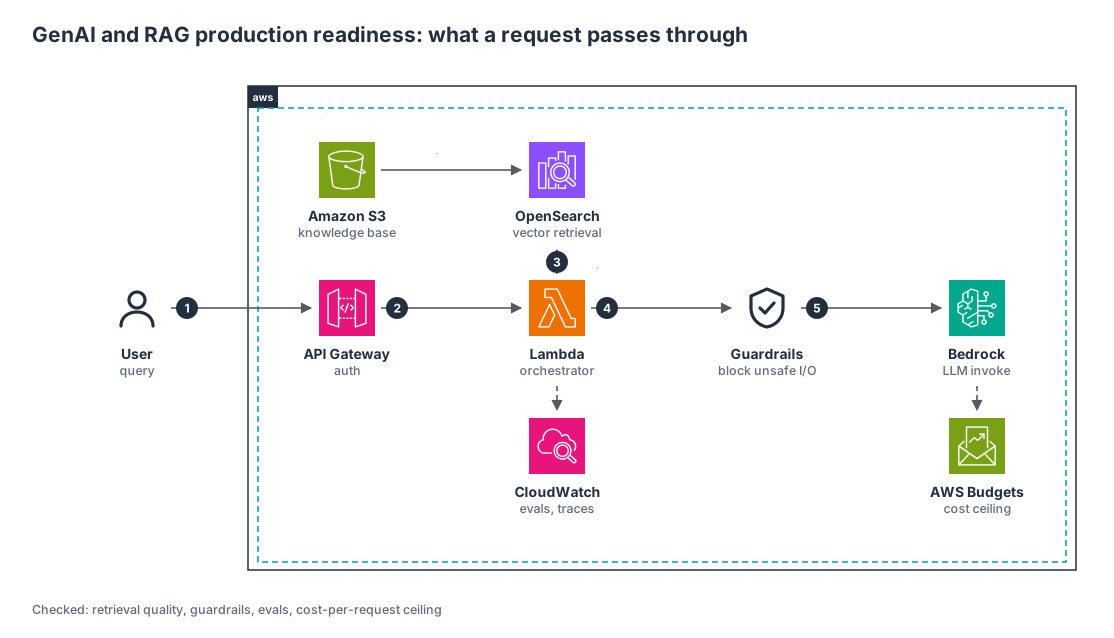
What you get
- - readiness report
- - eval plan
- - cost controls
- - retrieval and context recommendations
- - production runbook
What to bring
- - sample queries
- - source data map
- - current prompts or flow
The method behind this service, written up.
Case studies behind this service.
GenAI RAG Platform
Enterprise Knowledge Base
30+ min document hunts → sub-10s answers; hybrid RAG + semantic cache cut LLM spend ~60%.
- Documents
- 2M+
- Retrieval
- <1s
- LLM Cost Red.
- 60%
AI-Driven Development
Enterprise client (NDA) · Engineering enablement
Ad-hoc AI coding → governed Claude Code delivery loop with standards, app KBs, skills, commands, Jira context, and PR review gates.
- Program Model
- 4 steps
- Process Maps
- 7
- Artifact Plan
- 59 rows
LLM Infrastructure Training
AI code-generation training program (NDA)
Models wrote valid but unsafe IaC → 500+ reviewed CDK patterns, each paired with the security, cost and reliability reason behind it.
- Patterns Created
- 500+
- Templates Audited
- 500+
- Duration
- 8 months
Questions before you book.
Can you review an existing RAG or Bedrock implementation?
Yes. I review retrieval, prompts, evals, source attribution, latency, cost per request, logging, and fallback behavior.
Do you only work with AWS Bedrock?
AWS Bedrock is the strongest fit for this site, but the review can cover model-agnostic production concerns such as retrieval, evaluation, observability, and cost.