AWS Production Architecture Review
A fixed-scope review of one AWS production system: you get a risk register with the evidence behind each finding, a target architecture and a prioritized fix order, walked through with your engineers.
Your AWS setup works, but the bill, releases, permissions, and incidents are starting to feel hard to trust. This review is the paid first step: one bounded system, read against its own evidence, with a written fix order at the end.
 Request the reliability audit
Best fit
Series A-C SaaS and product teams that built fast and now need cost, reliability, IAM, observability, and deployment risk reviewed.
Timeline
10 business days
Proof frame
Sanitized examples can be discussed with sanitized or NDA-safe detail.
Symptoms first, architecture second.
The useful work starts by naming what is hurting, what can be measured, and what can be changed safely this week.
What you may be seeing
- AWS spend is rising without a clear owner
- Incidents require too much manual diagnosis
- IAM, accounts, and environments have drifted
- Rollback is vague or untested
How I find the cause
- account and environment structure
- IAM boundaries and network exposure
- CI/CD, rollback, and release ownership
- CloudWatch, X-Ray, logs, alarms, and cost hotspots
- scaling limits and failure paths
- GenAI/RAG readiness, when an AI workflow is in scope
The output has to survive handoff.
The point is not a prettier diagram. The point is a plan that names service boundaries, owners, rollback, cost drivers, and what gets observed.
I will not turn this into a generic cloud maturity deck. The output must name real risks, owners, and first moves.
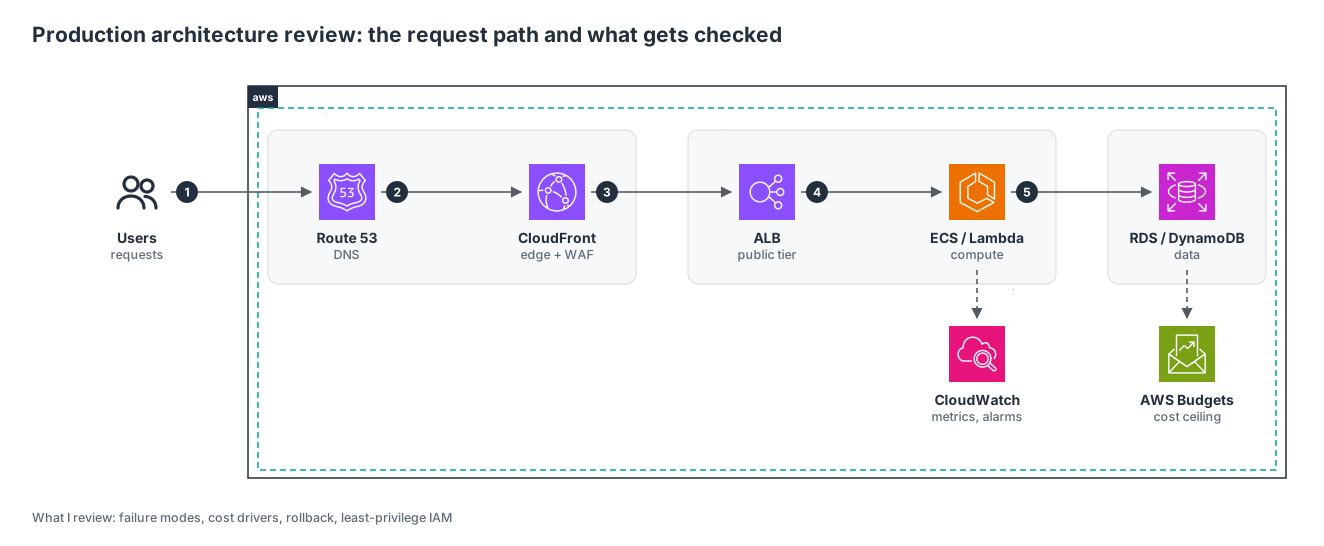
What happens, and what you have at each step.
01
Request & brief (30 min)
You share the trigger, architecture evidence, AWS or AI cost context, and decision owner. We bound the system and access in writing.
02
Evidence review (days 1 to 8)
I trace reliability, permissions, data flow, telemetry, cost, deployment, and failure behavior under load, partial failure, and retry storms.
03
You get the report (day 10)
You receive the evidence-backed risk register, target architecture, prioritized remediation plan, and a 90-minute walkthrough.
What you get
- - Current-state findings across reliability, IAM and tool permissions, data boundaries, observability, cost, deployment, rollback, and GenAI/RAG readiness
- - A risk register with evidence, severity, likely impact, effort, decision owner, and recommended control
- - A defensible target architecture and prioritized remediation roadmap
- - A focused AWS Cost & Reliability Audit when the bill is the symptom
- - A 90-minute walkthrough call, recorded, with your engineers in the room
- - Two weeks of async follow-up questions after delivery
What to bring
- - an architecture sketch, even a rough one
- - billing context: read-only Cost Explorer or CUR access
- - incident history and the alarms that fired
- - read-only access where it helps, bounded in writing first
The method behind this service, written up.
Case studies behind this service.
Enterprise IaC Standardization
Enterprise client (NDA)
Manual VPC sprawl + quarterly audit pain → standardized IaC, 70% faster setup, findings down 47 → 3.
- Setup Red.
- 70%
- Cost Red.
- 20%
- Compliance
- 100%
Event-Driven Commerce Migration
Major QSR e-commerce platform (Thailand) · Imaginato
Peak-hour monolith failures + inflated EC2 → 5M+ orders/mo, P99 <200ms, ~30% infra reduction.
- Orders/Mo
- 5M+
- Latency
- <200ms
- Cost Red.
- 30%
SaaS Platform Arch
ProdigyBuild
ClickOps + slow environments blocking ship → serverless API with a 99.9% availability target, 40% AWS cut, envs in minutes.
- Availability target
- 99.9%
- Cost Red.
- 40%
- Dev Velocity
- +60%
Questions before you book.
What do you review first in an AWS architecture review?
I start with the production path: traffic, identity boundaries, data stores, deployment flow, rollback, observability, and cost-driving services.
Is this a cloud maturity assessment?
No. A maturity assessment scores you against a framework. This review traces how your system fails and what it costs, then gives you a risk register and a fix order, not a scorecard.