Cloud Cost Optimization
Combined blind spend cut up to 55%; idle EC2 eliminated; SP coverage from 0% to 78% where it fit.
Reported engagement figures. See the results section for measurement context and limitations.
- Role
- Cloud Consultant
- Context
- Fintech / E-Commerce / SaaS
- Duration
- 2 weeks per client (6 weeks total)
- Team
- Solo consultant
Tech stack
- AWS Cost Explorer
- Trusted Advisor
- Python
- Terraform
- CloudWatch
- S3
- Lambda
- SNS
- QuickSight
- AWS Budgets


Business problem and production context.
Business problem
Three enterprise clients were overspending on AWS. One had significant idle EC2 inventory, another was running oversized RDS instances at low utilization, and the third had no Savings Plans despite predictable workloads, all with no visibility into per-team or per-service costs.
Architecture decision
Conducted 2-week architecture audits per client using AWS Cost Explorer, Trusted Advisor, and custom Python scripts. Implemented resource right-sizing (EC2, RDS, ElastiCache), converted qualifying workloads to Savings Plans and Reserved Instances, migrated batch jobs to Spot/Fargate Spot, enforced S3 lifecycle policies, and built FinOps dashboards with cost allocation tags and per-team budgets with SNS alerts.
Before and after.
Figures below come from the engagement account. Where no measurement source or period is provided, they are labelled reported. Workload scale, targets and engagement outcomes are different measures; past results are not a forecast for another system.
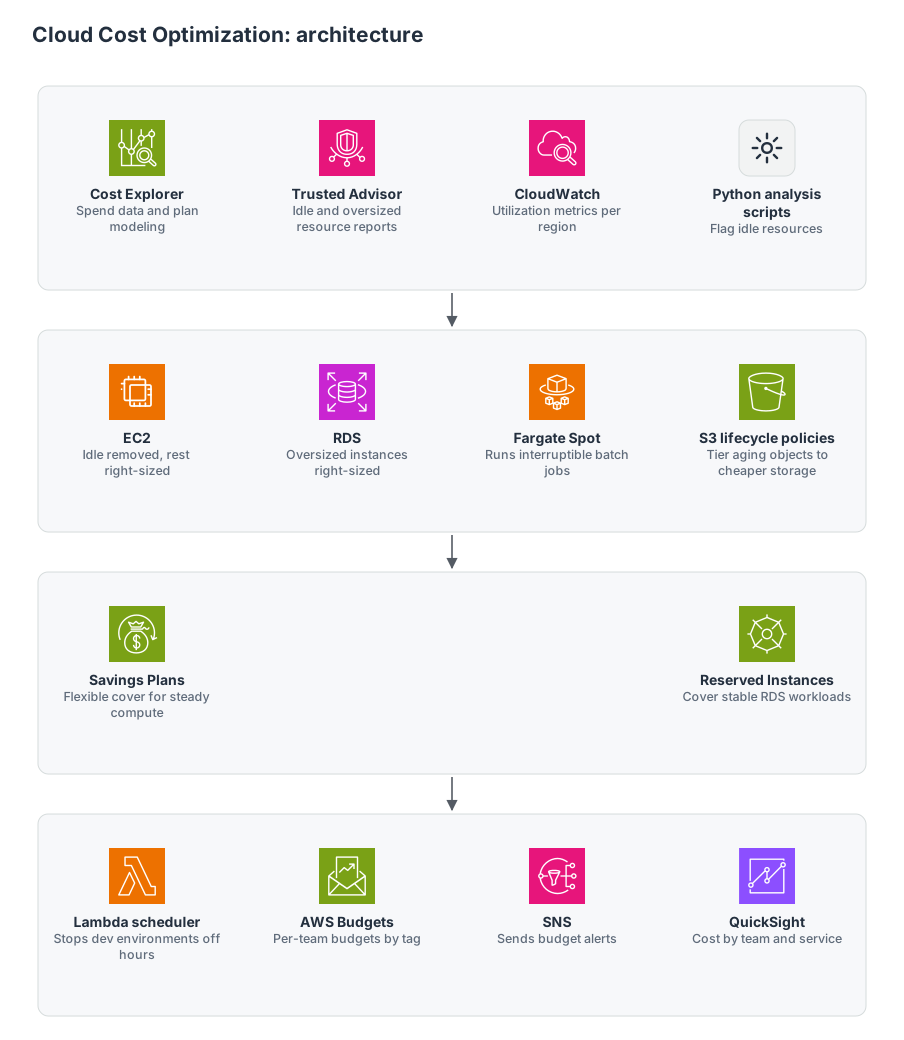
A repeatable audit that turns billing and utilization data into right-sizing, commitments and guardrails that keep the savings.
The audit-to-savings workflow, combined across three client accounts. ElastiCache right-sizing, EBS and Elastic IP cleanup, and each client's workload architecture are not shown.
Main components only; supporting services are left out.
1. Audit

Cost Explorer
Spend data and plan modeling

Trusted Advisor
Idle and oversized resource reports

CloudWatch
Utilization metrics per region
Python analysis scripts
Flag idle resources
2. Cut waste

EC2
Idle removed, rest right-sized

RDS
Oversized instances right-sized

Fargate Spot
Runs interruptible batch jobs

S3 lifecycle policies
Tier aging objects to cheaper storage
3. Commit

Savings Plans
Flexible cover for steady compute

Reserved Instances
Cover stable RDS workloads
4. Keep it saved

Lambda scheduler
Stops dev environments off hours

AWS Budgets
Per-team budgets by tag

SNS
Sends budget alerts

QuickSight
Cost by team and service
How it works, step by step
- 1Discovery pulls Cost Explorer data, Trusted Advisor reports and CloudWatch utilization across every region of each client account.
- 2Python scripts flag idle EC2, underused RDS, unattached EBS volumes and unused Elastic IPs.
- 3Idle resources are removed, EC2 and RDS are right-sized, and batch jobs move to Fargate Spot.
- 4Savings Plan options are modeled through the Cost Explorer APIs before anything is committed, with Reserved Instances kept for stable RDS workloads.
- 5S3 lifecycle rules, off-hours dev shutdown and tagged per-team budgets with SNS alerts hold the savings, and QuickSight shows cost by team, service and environment.
Guardrails
- Right-sizing uses peak percentile utilization and keeps headroom for performance
- Idle waste is separated from capacity that protects real traffic before any change
- Commitment term and payment options are modeled against workload stability before purchase
- Batch jobs on Fargate Spot handle interruption gracefully
- Per-team budgets are defined in Terraform, filtered by team cost allocation tag, and alert through SNS
Considered and not used
- Reserved Instances for compute: Savings Plans kept flexibility across instance families; RIs only for stable RDS.
- On-Demand for batch jobs: Fargate Spot with interruption handling cost far less for the same work.
- Aggressive right-sizing: Peak percentile metrics with headroom kept a performance safety margin.
My part of the work, separate from the team's.
The team behind the engagement is in the facts row above. These are the parts I was responsible for, and the artifacts that show the work.
Owned scope
- Multi-client AWS cost audit narrative with billing analysis, right-sizing, lifecycle policies, and FinOps automation
- Savings methodology that separates quick cuts from durable operating changes
- Cost visibility model for engineering and finance to discuss the same drivers
Evidence artifacts
What would fail first?
Every project has constraints. The useful work is naming them early enough that rollback, cost, and ownership are designed before an incident.
Mixed workloads
Savings came from different levers across compute, storage, databases, logs, and commitment strategy.
Business risk
Cutting cost could not reduce reliability or remove capacity required for real traffic.
Proof framing
Client details are sanitized, so savings need clear methodology and NDA-safe context.
Trade-offs accepted on purpose.
Production risks and how they were controlled.
Small steps, visible changes, fewer surprises.
- 01
Ran 3-day discovery per client: extracted Cost Explorer data, Trusted Advisor reports, and CloudWatch utilization metrics across all regions.
- 02
Built Python analysis scripts to identify idle resources (EC2 at <5% CPU, RDS at <8% utilization, unattached EBS volumes, unused Elastic IPs).
- 03
Modeled Savings Plan scenarios using AWS Cost Explorer APIs, comparing 1-year vs 3-year, All Upfront vs No Upfront, across Compute and EC2 families.
- 04
Implemented automated enforcement: S3 lifecycle policies (30-day IA, 90-day Glacier), Lambda-based schedulers for dev environment shutdown, and budget alerts at 80/100% thresholds.
- 05
Built QuickSight dashboards with cost allocation by team, service, and environment, giving CFOs and engineering leads visibility they never had.
What carries over to your system.
- The biggest savings were always the dumbest things: idle EC2 instances nobody remembered launching, oversized RDS instances from a load test 6 months ago, and unattached EBS volumes.
- Savings Plans require careful modeling. One client almost committed to a 3-year All Upfront plan on the wrong instance family. The analysis prevented an expensive multi-year mistake.
- Automated dev environment shutdown (7PM-7AM weekdays, all weekend) cut one client's non-prod spend substantially. The implementation took a couple of hours with Lambda + EventBridge.
Rollback path
High-risk cost changes were staged, monitored, and reversible; lifecycle and schedule-based changes were kept explicit.
Cost considerations
The public story stays sanitized: ₹50L+/yr client savings and selected 30-40% reductions where details can be shared.
Observability notes
Useful signals were cost by owner, unit cost, anomaly alerts, idle inventory, and post-change service health.
Further reading
Services built on this work
Have a similar production problem?
Send the current architecture, bill concern, deployment pain, or GenAI reliability issue. I will help you find the first real bottleneck.
 Request the reliability audit